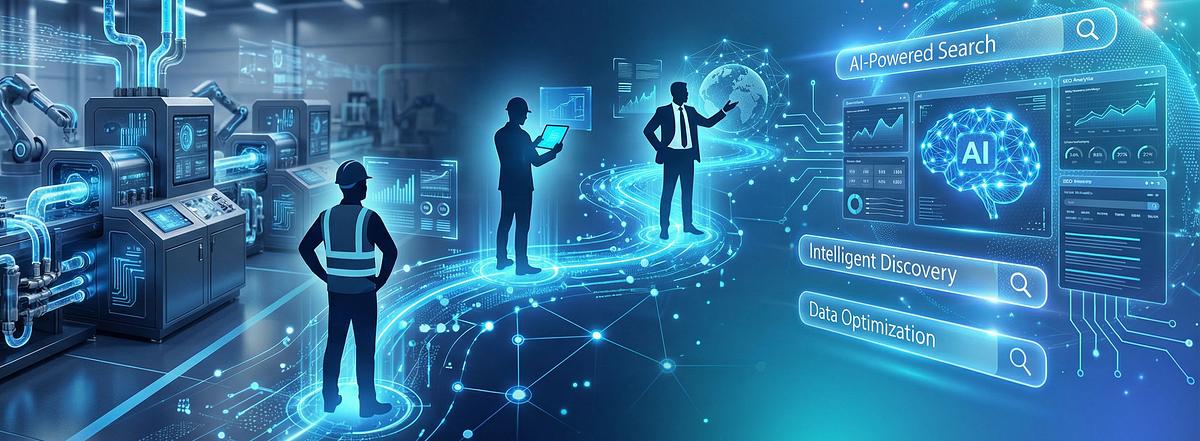
The New Reality: Why Manufacturing and Fluid Power Companies Must Deliver Persona-Based Digital Customer Journeys
The industrial landscape has fundamentally transformed, and the numbers tell a compelling story that B2B manufacturers can no longer ignore.
According to recent research, 80% of B2B sales interactions now occur in digital channels, with 73% of business buyers willing to spend $50,000 or more through digital self-service. More striking still: B2B buyers complete nearly 70% of their purchasing journey before ever contacting a sales representative, and when they do make first contact, 81% already have a preferred vendor in mind.
For companies in manufacturing, automation, and fluid power, this isn't just a trend—it's the new competitive landscape. Yet most industrial companies remain trapped in an outdated model, treating their website as a digital brochure while competitors build sophisticated, persona-driven digital experiences that intercept buyers during the critical research phase.
The Manufacturing Buyer Has Evolved—Have You?
The industrial buyer of 2026 bears little resemblance to the relationship-driven purchaser of a decade ago. Today's manufacturing and automation buyers:
- Complete 11.3-month buying cycles with buying groups averaging 11 people
- Use more than 10 digital channels during their research journey
- Conduct extensive online research across multiple vendors simultaneously
- Expect the same seamless digital experience they get on consumer platforms
- Increasingly rely on generative AI tools like ChatGPT and Perplexity to evaluate options
In the fluid power and automation sectors specifically, digitalization has become the dominant trend, with IIoT-enabled components, predictive maintenance systems, and smart hydraulics driving double-digit growth through 2032. Buyers researching these solutions expect vendors to demonstrate digital sophistication—not just in products, but in how they engage throughout the buying journey.
Yet here's the disconnect: while 89% of B2B buyers use generative AI at every stage of the purchase process, most industrial companies are still optimizing content for traditional search engines as if AI didn't exist.
Why Generic Digital Experiences Fail Industrial Buyers
The fundamental problem with most manufacturing websites isn't technical—it's strategic. They treat all visitors as a monolithic "customer" rather than recognizing that different personas have radically different needs, pain points, motivations, and decision-making processes.
Consider the reality of a typical fluid power equipment purchase:
The Plant Manager cares about uptime, reliability, and operational efficiency. They need content addressing total cost of ownership, maintenance intervals, and compatibility with existing systems.
The Procurement Director focuses on vendor stability, pricing structures, compliance requirements, and supply chain reliability. They want comparative analyses, case studies with measurable ROI, and clarity on contract terms.
The Maintenance Engineer needs technical specifications, installation requirements, troubleshooting resources, and documentation quality. They're evaluating whether your solution will make their job easier or harder.
The CFO evaluating capital equipment requires financial justification, payback periods, operational impact analysis, and risk assessment frameworks.
Each of these personas enters your digital ecosystem at different stages, with different questions, consuming different content formats. A one-size-fits-all website experience fails all of them simultaneously.
Research from HubSpot confirms this: businesses using buyer personas experience a 45% increase in engagement and a 2x higher conversion rate. Companies excelling at personalization generate 40% more revenue than average players, with personalization typically driving 10-15% revenue lift (and as high as 25% for top performers).
The Persona-Based Digital Journey Framework
At Ignite XDS, we've developed hundreds of detailed buyer personas for industrial clients in manufacturing, automation, and fluid power. Our research reveals that effective persona-based journeys require three interconnected elements:
1. Psychographic Depth Beyond Demographics
Traditional B2B personas stop at firmographics (company size, industry, revenue) and demographics (job title, seniority). Psychographics—the beliefs, values, motivations, fears, and decision-making triggers—are where competitive advantage lives.
For manufacturing buyers, psychographic profiling reveals critical insights:
- Risk tolerance: Is this buyer an early adopter of automation technology, or do they require extensive proof before implementation?
- Decision authority: Are they a recommender, influencer, or final decision-maker, and how does that shape their content needs?
- Pain point urgency: Is solving this problem a strategic initiative or a crisis requiring immediate action?
- Buying motivation: Are they driven by innovation, cost reduction, regulatory compliance, competitive pressure, or operational necessity?
These psychographic dimensions determine not just what content to create, but how to structure the entire digital experience for each persona segment.
2. Journey Mapping That Mirrors Real Buying Behavior
The B2B buyer's journey is not linear—it's iterative, with multiple stakeholders entering and re-entering at different stages. Effective journey mapping recognizes four critical phases:
Awareness Stage: Buyers recognize a problem and begin research. They're consuming educational content like blog posts, industry trend reports, and problem-definition resources. For manufacturing buyers, this might include content on Industry 4.0 transformation, predictive maintenance benefits, or energy efficiency regulations.
Consideration Stage: Buyers evaluate solution categories and approaches. They need comparison guides, technical specifications, implementation frameworks, and vendor landscape analyses. In fluid power, this includes content comparing hydraulic vs. pneumatic vs. electro-hydraulic solutions.
Decision Stage: Buyers narrow to specific vendors and products. They require case studies, ROI calculators, product demos, reference calls, and technical validation. Content must address implementation complexity, total cost of ownership, and change management.
Post-Purchase: Often overlooked, this stage drives retention and expansion. Buyers need onboarding resources, training materials, optimization guides, and troubleshooting documentation.
The key insight: different personas progress through these stages at different speeds, consuming different content formats, and requiring different types of validation at each stage. Journey mapping must account for these persona-specific variations.
3. Content Architecture Designed for Discovery
Here's where most industrial companies fail catastrophically: they create content for humans to read but don't structure it for machines (search engines and AI) to discover, understand, and recommend.
With 75% of B2B buyers preferring a rep-free digital experience, and nearly three-quarters completing their purchasing journey in 12 weeks or less using AI tools and Google Search, your content must be discoverable across both traditional search engines and generative AI platforms like ChatGPT, Perplexity, Claude, and Google's AI Overviews.
SEO and AI Search Optimization: The New Imperative
The convergence of traditional SEO and Generative Engine Optimization (GEO) represents the most significant shift in digital marketing since the mobile revolution. For industrial companies, adapting to this new paradigm isn't optional—it's existential.
The AI Search Transformation
Recent research reveals a systematic bias in AI search toward earned media (third-party authoritative sources) over brand-owned content. AI engines like ChatGPT and Perplexity prioritize content that:
- Answers questions directly and concisely
- Includes specific statistics, case studies, and quantifiable evidence
- Demonstrates E-E-A-T (Experience, Expertise, Authoritativeness, Trustworthiness)
- Uses structured data and semantic markup for machine readability
- Appears in authoritative third-party sources, industry publications, and review platforms
For manufacturing and automation companies, this means:
Your product pages matter less than your educational content. AI engines prioritize helpful, informational content over promotional material. A comprehensive guide on "How to Select Industrial Pneumatic Actuators for High-Cycle Applications" will outperform a product spec sheet.
Citation-worthy content beats keyword-stuffed pages. AI tools synthesize information from multiple sources. Content that provides unique insights, original research, detailed case studies, or expert analysis gets cited more frequently.
Schema markup and structured data are non-negotiable. AI engines rely on structured data to understand content context, relationships, and relevance. Implementing schema for products, FAQs, how-to guides, reviews, and technical specifications dramatically improves AI discoverability.
The Persona-SEO Integration
Here's where persona-based content strategy and AI search optimization converge powerfully:
Intent-based content replaces keyword-based content. Rather than targeting isolated keywords like "hydraulic valve," persona-driven content addresses specific searcher intent: "How to prevent hydraulic valve failures in high-temperature environments" speaks directly to maintenance engineers' pain points.
Conversational queries match persona language. With AI search, buyers ask natural language questions: "What's the best fluid power solution for a 200-ton injection molding machine?" Optimizing for these conversational queries means understanding how each persona articulates their needs.
Question-based content architecture. Structure content around the specific questions each persona asks at each journey stage. Use actual questions as H2 and H3 subheadings, then provide direct, complete answers. This serves both human readers and AI parsing.
Topic clusters establish authority. Rather than isolated blog posts, create comprehensive topic clusters: a pillar page on "Industrial Automation for Mid-Size Manufacturers" linking to detailed pages on sensors, controls, actuators, integration, ROI analysis, and implementation planning. This signals topical authority to both search engines and AI.
Real-World Example: AI Search Optimization for Fluid Power
Consider a fluid power distributor implementing persona-based AI search optimization:
Before: Generic product pages with technical specs. Website traffic stagnant. Leads came primarily from trade shows and existing relationships.
After: Created persona-specific content journeys:
- For Plant Managers: "5 Warning Signs Your Hydraulic System Needs Upgrading" → "Total Cost of Ownership Calculator" → "Predictive Maintenance ROI Case Study"
- For Maintenance Engineers: "Troubleshooting Pneumatic Actuator Performance Issues" → "Component Compatibility Guide" → "Installation Best Practices Video Series"
- For Procurement Directors: "Fluid Power Vendor Evaluation Checklist" → "Supply Chain Risk Assessment Framework" → "Contract Terms Negotiation Guide"
Each content piece optimized for both traditional search and AI platforms using:
- Question-based headings matching persona language
- Detailed schema markup for FAQs, how-to content, and products
- Specific statistics and case study data for AI citation
- Cross-linking within topic clusters
- Distribution to third-party industry publications for earned media authority
Results: 62% increase in organic traffic, 40% increase in qualified leads, and 28% shorter sales cycles as buyers arrived more informed and ready to engage.
Persona Psychographic Matching: Beyond Lead Generation Into Sales
This is where most B2B industrial companies leave massive value on the table: they invest in personas for marketing but fail to extend persona-based approaches into sales activities, customer success, and account management.
The reality is that persona psychographic matching should inform every revenue-generating activity. Here's how:
Sales Enablement and Persona Alignment
When a lead reaches the sales team, the entire sales approach should adapt to the specific persona and their psychographic profile:
For Risk-Averse Personas: Sales conversations emphasize proven track records, reference customers in similar applications, implementation support, and risk mitigation strategies. Sales materials include detailed case studies, third-party validation, and phased implementation roadmaps.
For Innovation-Driven Personas: Sales conversations focus on competitive advantage, cutting-edge technology, industry leadership positioning, and early-adopter benefits. Materials showcase R&D capabilities, patent portfolios, and future product roadmaps.
For ROI-Focused Personas: Sales conversations lead with financial justification, payback periods, operational efficiency gains, and total cost of ownership analysis. Materials include ROI calculators, financial modeling tools, and quantified business case frameworks.
For Technical Evaluators: Sales conversations dive into specifications, compatibility, integration requirements, and technical architecture. Materials provide detailed engineering documentation, CAD files, API documentation, and technical support processes.
Research shows that 82% of B2B companies use persona models, yet many fail to equip sales teams with persona-specific enablement materials. Companies that do see dramatic results: sales cycles shorten by 40%, conversion rates increase, and average deal sizes grow as sales conversations align precisely with buyer motivations.
Account Management and Customer Success
Persona psychographics don't end at the sale—they should inform the entire customer lifecycle:
Onboarding sequences tailored to persona learning styles and adoption motivations. A hands-on maintenance engineer needs different onboarding than an executive sponsor.
Customer success touchpoints aligned with persona-specific success metrics. What constitutes "value" varies dramatically by persona—uptime for operations, cost savings for finance, ease of use for technicians.
Expansion and upsell motions triggered by persona-specific signals. A plant manager showing interest in energy efficiency content represents a different expansion opportunity than a procurement director researching volume discount structures.
Renewal strategies that address persona-specific retention risks. Risk-averse personas need reinforcement of reliability and partnership continuity. Innovation-driven personas need evidence of ongoing product evolution.
The Revenue Impact
Companies implementing persona-driven approaches across the full revenue lifecycle report:
- 5-15% revenue increases from personalization alone
- 40% more revenue than competitors not using advanced personalization
- 10-30% improvements in marketing efficiency
- 89% of marketers reporting positive ROI from personalization efforts
For a $20M industrial manufacturer, a 12% revenue increase from persona-driven digital experience and sales enablement represents an additional $2.4M in annual revenue—often with minimal incremental cost.
Implementation Roadmap: Getting Started
For manufacturing, automation, and fluid power companies ready to transform their digital customer experience:
Phase 1: Foundation (60-90 days)
- Develop 3-5 detailed buyer personas using customer interviews, sales team input, behavioral data, and psychographic research
- Audit existing content against persona needs and journey stages
- Implement core technical infrastructure: schema markup, site structure optimization, analytics tracking, and AI crawler accessibility
- Map customer journey touchpoints for each persona from awareness through post-purchase
Phase 2: Content Transformation (90-180 days)
- Create persona-specific content journeys addressing each stage with appropriate formats and messaging
- Optimize for both traditional SEO and AI search using intent-based keywords, conversational queries, and structured data
- Develop sales enablement materials aligned with persona psychographics
- Publish content across owned and earned channels to build AI citation authority
Phase 3: Sales Integration (180+ days)
- Train sales teams on persona-based selling approaches and enablement resource usage
- Implement persona-triggered automation for lead nurturing and sales handoffs
- Extend persona approaches into customer success and account management
- Continuously optimize based on performance data and evolving buyer behaviors
The Competitive Imperative
The industrial buyers of 2026 are already conducting persona-driven, AI-assisted research to evaluate vendors. They're comparing capabilities, validating claims, and forming vendor preferences—all before you know they exist.
The question isn't whether to implement persona-based digital customer journeys optimized for AI search. The question is whether you'll do it before your competition establishes an insurmountable advantage.
With 90% of B2B prospects completing research digitally before contacting sales, 75% willing to switch suppliers for better digital experiences, and 89% using generative AI throughout the buying process, the cost of inaction compounds daily.
The good news: most industrial companies remain stuck in outdated approaches, creating a massive opportunity for manufacturers, automation providers, and fluid power companies willing to embrace persona-based, AI-optimized digital transformation.
The manufacturing sector has always rewarded those who invest in better processes, superior systems, and operational excellence. Digital customer experience is simply the next frontier where that same principle applies. Companies that build sophisticated, persona-driven digital journeys will capture disproportionate market share in the years ahead.
The infrastructure is available. The buyer behavior data is clear. The competitive advantage is substantial.
The only remaining question: Will you lead or follow?
About Ignite XDS
Ignite XDS is an operational strategic marketing and implementation firm specializing in manufacturing, automation, and industrial B2B companies. We develop persona-driven customer experience strategies, AI-optimized content architectures, and sales enablement systems that drive measurable revenue growth. Our client portfolio includes manufacturers, fluid power distributors, automation providers, and industrial service companies across North America, with documented results including 647% ROI, 62% organic traffic increases, and 28% shorter sales cycles.
If your industrial company is ready to transform digital customer experience into a competitive advantage, let's talk. https://www.ignitexds.com/contact