The Starting Point Problem: Why Most Growth Strategies Fail Before They Begin
Most companies don't have a growth problem.
They have a starting point problem.
And until you understand where you actually stand—not where you think you stand—every growth strategy you pursue will feel chaotic, inefficient, and worse: ineffective.
The Fundamental Disconnect
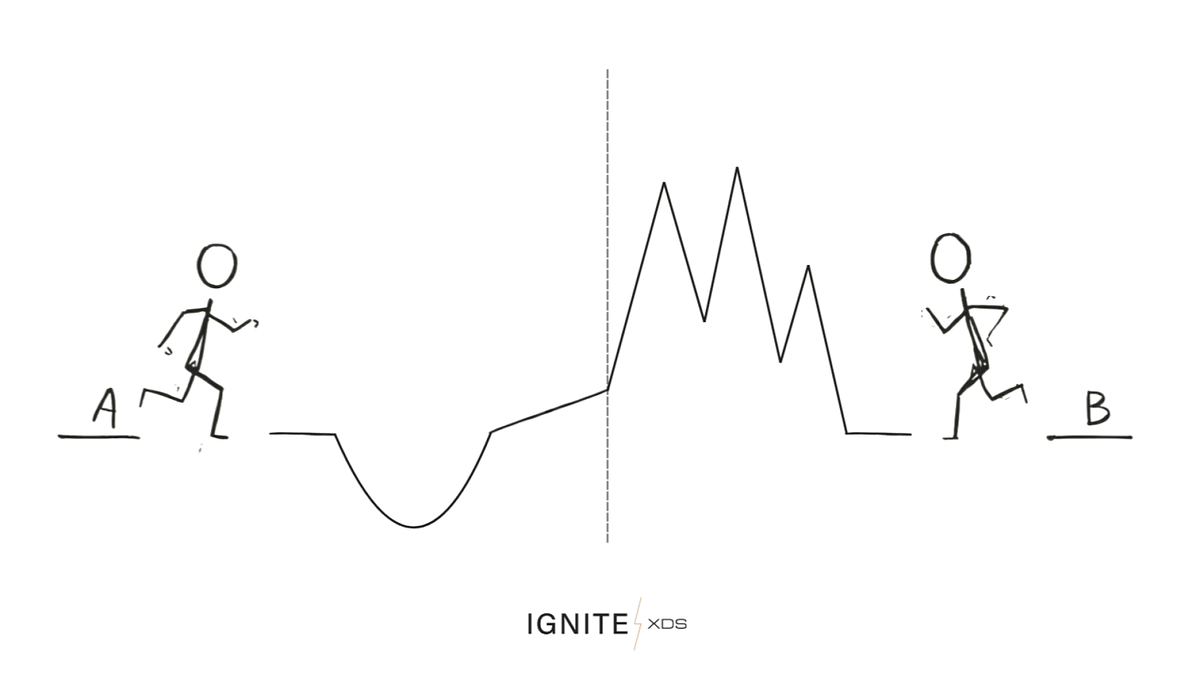
Think about it. Two different businesses can want the exact same outcome: more revenue, more valuation, more momentum, more market share. Same goals. Same vision. Same aspirations.
Yet they need completely different moves to get there.
- Company A is constrained by demand. Their product works. Their customers love them. They've cracked the code on product-market fit, but they don't have enough people who know about them. Their problem is visibility, reach, and getting in front of the right prospects.
- Company B is constrained by complexity. They're getting inquiries. They have demand signals. But their operations can't keep up. Their sales process is broken. Their team can't execute. Their pricing doesn't align with their value. Their brand promise doesn't match their customer experience.
Here's the critical insight: If you treat both companies the same, you don't get growth. You get friction.
Company A doesn't need better operations—it needs market penetration. Throw marketing and sales firepower at the problem. Scale awareness. Drive pipeline. Remove friction in conversion.
Company B doesn't need more demand—it needs organizational transformation. More marketing will only surface problems you can't solve. You'll generate leads you can't service. You'll create expectations you can't meet.
The cost? Damaged brand reputation, customer churn, wasted marketing spend, and a team that's exhausted from the gap between what you're promising and what you're actually delivering.
Why Most Growth Strategies Fail
The biggest mistake companies make is trying to solve a complexity problem with a demand strategy—or trying to solve a demand problem with a complexity strategy.
You see it constantly:
- A manufacturing company hires a marketing agency to "generate more leads" when their real problem is their sales team can't close deals
- A service business invests in brand rebranding when their actual issue is they can't deliver consistent customer experience
- A technology company scales their marketing budget when their operations literally can't fulfill the orders they're already getting
Each of these situations feels like a growth problem. In reality, it's a starting point misalignment.
And here's what makes it worse: most companies never even diagnose the real problem. They sense something isn't working. Growth feels chaotic. Initiatives don't stick. Results don't materialize as expected. So they blame the tactics, fire the vendors, or worse—they blame themselves.
But the tactics were never the problem. The starting point was.
The Role of Perception vs. Reality
There's another layer to this: the gap between where you think you are and where you actually are.
We work with business leaders all the time who believe they have a demand constraint when they actually have an operational one. They believe their brand positioning is crystal clear to the market when customer interviews reveal significant confusion. They believe their team is aligned on strategy when departmental silos are sabotaging every initiative.
The cost of these misalignments is staggering.
Marketing spend gets wasted on the wrong audience. Sales teams target the wrong prospects. Operations break under pressure they didn't anticipate. Leadership makes decisions based on incomplete or inaccurate information.
The solution isn't more effort. It's more clarity.
The Ignite XDS Approach: Position-Message-Process
This is exactly why Ignite XDS developed the Position-Message-Process (PMP) methodology.
We don't start with growth tactics. We start with honest, rigorous truth-telling about where your company actually is—not where leadership thinks it is.
Position Identification
The first pillar is Position: defining your company's true position in the marketplace and identifying the specific constraint you're facing.
Through our Discovery Process, we conduct a comprehensive audit across six critical areas:
- Customer Exploration - Why do your customers actually buy from you? What's their perception of your brand? Where are the gaps between what you promise and what you deliver?
- Sales & Marketing Alignment - Are your sales and marketing teams talking about the same target customer? Are they pursuing the same opportunities? Or are they speaking different languages?
- Competitive Landscape - How do you actually stack up against competition? Is your positioning defensible? Are you trying to compete on dimensions where you can't win?
- Operations & Culture - Can your team actually execute on the growth you're planning? Do you have the right people, processes, and systems to support scaling?
- Financial Position - Do you have the runway and resources to sustain a growth initiative? What's your actual unit economics?
- Market & Demand - Is there real demand for what you're selling? Or are you trying to create demand in a market that doesn't actually want your solution?
This isn't a surface-level exercise. This is deep scrutiny—the kind that challenges assumptions, exposes blind spots, and creates clarity.
The output isn't just a diagnosis. It's a clear understanding of your starting point: Are you demand-constrained or complexity-constrained? Where is the real bottleneck to growth?
Message Development
Once you understand your position, the second pillar is Message: crafting the right narrative for your market.
Here's what most companies get wrong: they build messaging around features and benefits. "We're faster." "We're cheaper." "We're more reliable."
But that's not what moves people. Emotion moves people.
Your message needs to speak to the emotional reality of your customer's world. What keeps them awake at night? What are they frustrated by? What future state do they envision for themselves?
Your message is the bridge between their current pain and the better future you enable.
For a demand-constrained company, the message might focus on disruption, possibility, or opportunity. "Your competitors are already doing this. Don't get left behind."
For a complexity-constrained company, the message might focus on relief, simplification, or empowerment. "We handle the complexity so you can focus on what matters."
The message has to align with your actual position. Get it right, and your brand becomes a magnet for the right customers. Get it wrong, and you attract the wrong people—wasting resources and creating frustration on both sides.
Process Implementation
The final pillar is Process: building the operational reality that delivers on your position and message.
This is where most strategies fail. Companies get excited about the vision, craft a compelling message, but then fail to build the systems that actually deliver.
If you're demand-constrained, your process needs to be built for scale and reach: distribution efficiency, market penetration, lead generation velocity.
If you're complexity-constrained, your process needs to be built for excellence and reliability: operational excellence, quality, customer experience, team capacity.
The process has to be intentional. It has to be documented. And it has to be maintained.
This is where we move from strategy to execution. This is where good intentions become measurable results.
From Chaos to Intention
Here's the transformation that happens when you get the starting point right:
Before: You're implementing tactics that feel disconnected from your real constraints. You're chasing initiatives that don't move the needle. Your team feels like they're working hard without getting traction. Growth feels chaotic, unpredictable, and frustrating.
After: You understand exactly where you are. Your strategy aligns with your actual constraint. Your team is pulling in the same direction. You're implementing initiatives that directly address your bottleneck. Growth stops feeling chaotic and starts feeling intentional.
The difference isn't the amount of work. The difference is the quality of work.
When you're working on the right problem—the one that's actually constraining your growth—everything changes. Efficiency improves. Morale improves. Results improve.
The Data Is Talking
Your business is constantly sending you signals. Revenue patterns are telling a story. Customer feedback is pointing to problems. Operational bottlenecks are screaming for attention. Team dynamics are revealing misalignment.
The question is: Are you listening?
Most companies aren't. They're moving too fast. They're reacting to the most urgent noise. They're not taking time to understand what the data is actually saying.
This is where strategic clarity becomes a competitive advantage. This is where intentional growth becomes possible.
Where Are You Actually Standing?
Before you pursue your next growth initiative—before you invest in marketing, restructure your sales team, or launch a new product—take a step back.
Ask yourself:
- Do I truly understand where my company stands right now?
- Have I diagnosed whether I'm demand-constrained or complexity-constrained?
- Does my growth strategy align with my actual constraint?
- Is there alignment between my position, message, and operational capability?
- Am I working on the right problem, or just the loudest problem?
Getting this right transforms everything.
Your data is talking. AI helps you listen—and act. But first, you have to know what you're listening for.
That starts with understanding your starting point.
What's Your Starting Point?
If you're uncertain about where your company truly stands—if growth feels chaotic rather than intentional—this might be the conversation you need to have. https://www.ignitexds.com/fit-call
At Ignite XDS, we've spent over 35 years perfecting the Discovery Process to help companies understand their actual position and design a growth strategy aligned with where they really are.
The result? Faster decision-making. Smarter operations. And bottom-line growth that actually sticks.
Your business is talking. The question is: are you ready to listen?