The $5M Valuation Gap: Your Invisible Digital Presence Is Costing You More Than You Think
I've spent 35+ years working with hundreds of 8- and 9-figure industrial companies—fluid power distributors, automation integrators, precision manufacturers.
Companies with exceptional engineering talent, loyal customer bases, and products that genuinely outperform the competition. And yet, so many of them have stalled.
Not because of their capabilities. Not because of market conditions. But because they've become invisible during the most critical phase of the modern buying journey.
Here's the uncomfortable truth: If your brand isn't visible where your buyers are looking, you effectively cease to exist in their purchasing journey.
The "Good Old Days" Are Gone—And They're Not Coming Back
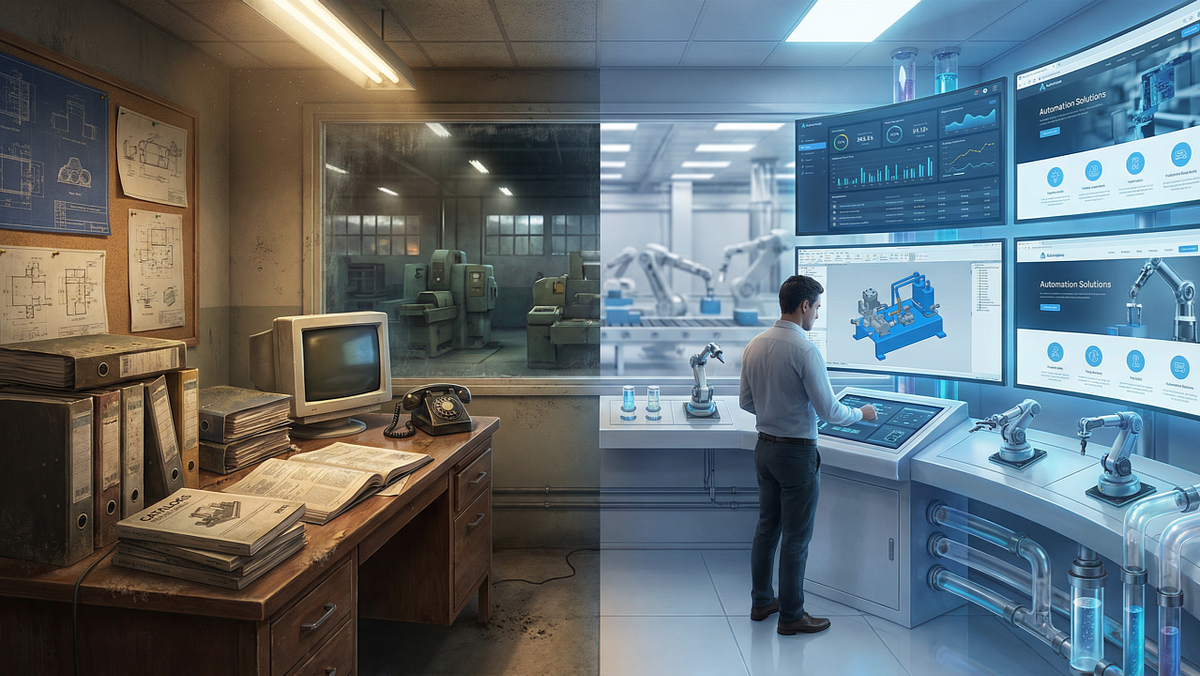
For decades, industrial companies thrived on trade shows, word-of-mouth referrals, printed catalogs, and direct sales calls. These strategies built strong relationships and served their purpose.
But the landscape has fundamentally shifted.
Today's industrial buyer—whether a 25-year veteran engineer or a millennial procurement manager—begins their purchasing journey online. The data is staggering:
- 70-90% of the B2B buying journey happens digitally before a potential customer ever contacts your sales team
- 84% of people searching for manufacturing services start their journey online
- 82% of manufacturers compile a shortlist before engaging with any sales representatives
- 73% of B2B buyers say they pay attention to a supplier's website when deciding whether to submit RFIs
- 65% of industrial buyers now make at least one online purchase—up from just 45% in 2018
Read that last statistic again. In seven years, online industrial purchasing went from a novelty to the norm. And 58% of those purchases now occur outside traditional distributor relationships.
Where does that leave you if your digital presence is an afterthought?
The Real Cost of Digital Invisibility
When I talk to manufacturing and fluid power executives about digital presence, I often hear: "Our customers know us. They pick up the phone." Or: "We're an engineering company, not a marketing company."
I understand. But here's what that mindset is actually costing you:
You're not entering consideration sets. Industrial buyers research extensively before engaging suppliers. Manufacturers without a strong digital presence during this research phase never make the shortlist. You're losing deals before you ever knew you were competing for them.
Your competitive positioning is eroding. With 2,392 fluid power equipment distributors in the U.S.—a number that's actually declined 1.5% annually since 2020—the survivors are the ones adapting. Your competitors who invested in digital are capturing the demand you're missing.
You're being perceived as a commodity. I've seen companies with genuinely superior technology get passed over because their website looked like it was built in 2008. When buyers can't see your value proposition clearly articulated online, they default to price comparisons. And you become just another vendor.
Your customer acquisition costs are inflating. Poor digital presence forces dependence on outbound sales tactics—cold calls, trade shows, relationship selling. These are expensive, unpredictable, and increasingly ineffective with digitally-native buyers.
The Industry Is Transforming—With or Without You
The fluid power market is projected to reach $85.9 billion by 2031. The winners in this growth won't be determined by technical capability alone.
Companies capable of integrating mechanical expertise with smart technologies will have a distinct competitive edge. But here's what many industrial leaders miss: that integration isn't just about IoT sensors and predictive diagnostics. It's about how you communicate your capabilities to a market that's researching you online before they ever pick up the phone.
The shift toward Industry 4.0, electro-hydraulic solutions, and AI-driven manufacturing creates enormous opportunity. But that opportunity goes to companies that buyers can actually find and understand during their digital research phase.
What "Digital Presence" Actually Means
Let me be clear: I'm not talking about posting more on social media or running Google Ads. Those are tactics, not strategy.
A meaningful digital presence for an industrial company means:
1. A website that translates technical excellence into business value. Not just specs and CAD drawings—but clear articulation of how your capabilities solve real operational problems. What does your valve response time superiority mean? It means 22% reduction in production line downtime. That's what belongs on your website.
2. Content that meets buyers where they are. Your prospects are searching for solutions to specific problems. Are you showing up with answers? Technical articles, case studies, application guides, and comparison resources that demonstrate expertise.
3. A digital experience that matches your operational quality. If you're a precision manufacturer and your website loads slowly, has broken links, or looks dated—what message does that send about your attention to detail?
4. Visibility in the channels where research happens. Search engines, industry publications, LinkedIn, vertical platforms like ThomasNet. Your buyers are looking. Are you there?
The Wake-Up Call
Here's what I tell the executives I work with: Your digital presence isn't a marketing expense. It's a business valuation factor.
When companies come to us stuck at $15-30 million in revenue—great technical capabilities but perceived as commodity suppliers—the pattern is consistent. They've been winning on product quality but losing on market perception. And market perception, in 2026, is built digitally.
The industrial companies that will thrive in the next decade aren't necessarily the ones with the best engineers (though that matters). They're the ones that make it easy for buyers to find them, understand their value, and trust their capabilities—before the first sales conversation ever happens.
The question isn't whether you can afford to invest in your digital presence. It's whether you can afford the invisible cost of neglecting it.
Feature from Mitch Lipon, Ignite XDS Founder & President
If your growth has stalled and you suspect your digital presence might be part of the problem, let's talk. At Ignite XDS, we help fluid power, automation, and manufacturing companies transform how the market perceives and finds them. Sometimes the biggest valuation gaps aren't in your products—they're in your positioning.