The Invisible Table: Why Your Restaurant Brand May Already Be a Ghost
The Question Nobody Asks Until It's Too Late.
Here is a question worth sitting with.
When a potential guest pulls into your market for the first time — a tourist, a snowbird, a food-curious couple searching from their hotel room — what happens when they open ChatGPT or Perplexity and type, "Where should we eat tonight near [your city]?"
Does your name come up?
If you are operating a multi-rooftop restaurant group and you are not certain of the answer, this article is for you. Because the brand you have spent years building may already be invisible to the guests who are deciding right now.
How the Decision Gets Made Now
The way guests choose a restaurant has changed permanently, and most multi-rooftop operators have not caught up to the new reality.
The decision of where to eat is no longer made at a hostess stand. It is no longer made on a Google results page. It is made in a chat window, before a guest ever leaves their hotel room, their car, or their couch. Research confirms that over 90% of restaurant customers consult online resources before deciding where to dine. But the shift that happened in 2025 goes far beyond Google.
Google AI Overviews, ChatGPT, Perplexity, and Gemini now answer restaurant questions directly, returning a curated shortlist of two to five options with no click required. By the end of 2025, more than 60% of searches were resolved without a single click to any website. And 40% of Gen Z users now turn to AI chatbots for restaurant recommendations before they open Google at all.
That shortlist is the entire decision. If your concept is on it, you compete. If it is not, you were never in the room.
The most sobering data point: 83% of restaurants do not appear in AI-generated local recommendations at all. That is not a ranking problem. That is an existence problem.
The Invisible Table
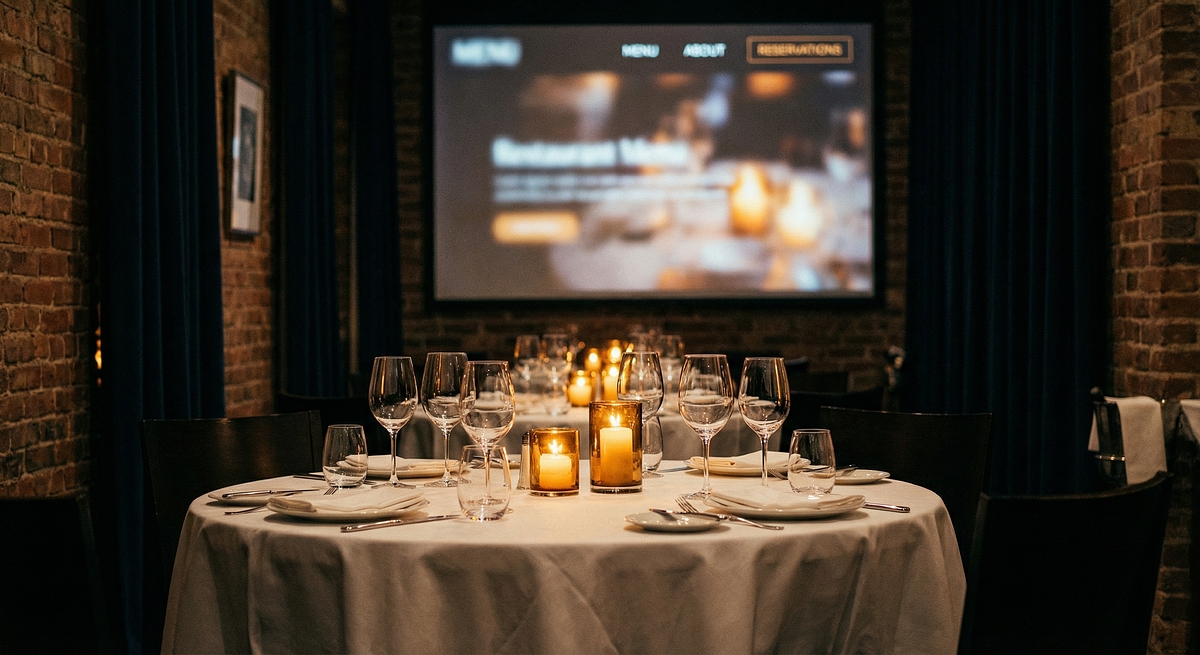
This is what the Ignite XDS team calls the Invisible Table.
You have built something real. Multiple locations. A loyal following. Years of earned reputation, hard-won reviews, and a dining experience your regulars love. You may have a catering division, a private dining room, a portfolio of concepts that represents a lifetime of work.
But if the guest who matters most — the first-time visitor, the event planner building a shortlist in ninety seconds, the family deciding over a hotel Wi-Fi connection — types a question into an AI tool and your name does not surface, you are sitting at a table that is fully set with nobody coming.
The financial reality behind this is sharp. Visitors who arrive via an AI citation convert at 4.4 times the rate of standard organic traffic, with some data putting that multiplier as high as 23x. The most motivated, ready-to-spend guests in your entire customer funnel are being pre-sold before they ever see your menu. They just are not being pre-sold to you.
At the same time, organic click-through rates on queries that now trigger AI Overviews have dropped 61%. The old search game is not slowing down. It has been replaced.
Why Multi-Rooftop Groups Face This Problem Differently
Every restaurant faces some version of this challenge. But operators running multiple concepts face it in ways that are categorically more complex and far more consequential.
When you operate five, eight, or twelve dining concepts, each with its own name, its own digital footprint, and its own local identity, you need each concept to be individually visible and the portfolio to tell a coherent story. Most multi-concept groups have neither. The umbrella brand lives as a text directory. Individual concepts compete in AI search without the authority signals of a connected enterprise. And the brand story that should be doing the heaviest lifting — the one about who built this, why, and what makes it worth choosing — exists nowhere in a format that AI can read, surface, or recommend.
The valuation dimension makes this even more urgent. Restaurant M&A buyers in 2025 and 2026 are explicit: deals go to brands with documented digital presence, scalable infrastructure, and coherent brand equity, not just operational reputation. The gap between what a multi-rooftop group is operationally and how it appears digitally is the precise gap that depresses enterprise value in a sale, a partnership, or a capital raise.
A business that cannot tell its own story cannot justify the premium its track record deserves.
The Brand Story That Is Not Working for You
Here is where many multi-rooftop operators are unknowingly losing ground.
The origin story. The decades of community trust. The sustainable sourcing commitment. The multi-generational ownership. The 700 employees and the catering arm and the hotel partnership. These are not just compelling narratives — they are precisely the signals that AI search engines are designed to surface and reward. Google's own quality guidelines call them E-E-A-T signals: Experience, Expertise, Authoritativeness, and Trustworthiness.
Most operators have all four in abundance. Almost none of it is deployed in a format AI can find.
Instead, the story lives in a podcast episode, a PDF menu, a social media bio, and a website that functions as a location directory. Competitors with shorter histories, fewer concepts, and thinner reputations are being recommended ahead of you — not because their story is better, but because their story is structured and machine-readable.
Every week that your origin story, your portfolio scale, and your menu live outside AI-readable digital formats is a week your competitors are training the machines to prefer them. And that preference compounds.
What Needs to Change
Closing the Invisible Table gap is not about chasing the latest social media trend or launching a rebrand. It requires a structured, strategic approach to how the brand presents itself to the systems now making the introductions.
That means building AI-readable content that reflects the actual depth of what has been built. It means creating a coherent portfolio narrative that connects individual concepts under a unified brand story. It means ensuring menus, sourcing commitments, event capabilities, and location details exist in formats that AI systems can index, trust, and recommend.
It also means understanding, from the outside looking in, exactly where the gaps are today — before another season passes with the wrong competitors showing up in the answer.
The Outside-In Assessment
At Ignite XDS, the work with multi-rooftop restaurant groups begins with an Outside-In Assessment — an independent, intelligence-first analysis of how your brand is actually seen before any conversation happens.
The process does not start with a questionnaire. It starts with research, examining your brand the way a potential guest, a catering client, a hotel development partner, or a private equity acquirer would encounter it. Every concept's digital footprint gets audited. AI search results get tested across the highest-value query categories for your market. The gap between the brand you have built and the brand the market currently sees gets documented clearly.
The findings are delivered in five structured reports covering your outside-in market perception, your AI-era visibility, your buyer journey experience, and your highest-priority revenue and valuation opportunities — ranked by speed to impact.
No assumptions. No generic recommendations. Just a clear picture of where you stand and what it would take to close the gap.
The Cost of Waiting
Across five core AI query clusters for a typical multi-concept Gulf Coast restaurant group, the conservative annual revenue at stake from missed guest acquisition alone runs into seven figures — before accounting for catering lifetime value, corporate account relationships, or enterprise valuation impact.
A single corporate event booking is worth $15,000 to $45,000. A pre-sold tourist family is worth the visit, the review, and the return trip. A seasonal regular who cannot find confirmation that your brand is still what they remember will simply choose somewhere that made it easier to say yes.
None of this disappears with a single dramatic moment. It erodes quietly, week by week, in favor of whoever gave the machines something to work with.
A Direct Invitation
If you operate a multi-rooftop restaurant group and you are not certain that your brand is visible, legible, and compelling to the AI systems now writing your guests' shortlists, this is the moment to find out.
Ignite XDS works with multi-rooftop hospitality enterprises to close the gap between operational excellence and market visibility — and to build the brand infrastructure that protects both revenue and enterprise value for the long term. The engagement begins with an Outside-In Assessment, before any sales conversation, because the best way to earn a relationship is to demonstrate value first.
Reach out today at https://www.ignitexds.com/contact
The table you have built deserves to be found.
Read the research further: Zero Click Dining
Watch The Invisible Table presentation from Performance Foodservice Foodcentric 2026 on YouTube.
Mitch Lipon is the President of Ignite XDS, an operational marketing firm specializing in brand equity, market visibility, and growth strategy for multi-location hospitality enterprises. Ignite XDS has delivered an average 1.8x valuation increase over 37 months across client engagements. Learn more at ignitexds.com.