The Zero-Click Dining Decision - Why 70% of Your Guests Choose Before They Ever See Your Website
I was sitting in on a client call earlier this year - a well-run independent restaurant in Naples, one of the best on Fifth Avenue South - when the owner said something that stopped me cold.
"Our website traffic is actually up. But the phones aren't ringing like they used to."
She couldn't figure out the disconnect. I could. And it's the same disconnect quietly draining revenue from hundreds of restaurants across Naples, Fort Myers, Bonita Springs, Cape Coral, and Estero right now (read the research).
The guests found her. They saw her restaurant. They even decided to eat there.
They just never visited her website to do it.
The Funnel You Learned Doesn't Exist Anymore
For three decades, restaurant marketing operated on a predictable sequence. A guest had a craving. They opened Google. They clicked through to blue links. They browsed menus. They read reviews. They made a decision and picked up the phone or clicked "Reserve."
That funnel has collapsed - not gradually, but completely.
Up to 70% of restaurant searches now end in what's called a "zero-click result." The dining decision is made before the guest ever visits a restaurant's website. By the end of 2025, more than 60% of ALL Google searches across every category were resolved without a single click to an external website, according to research from Datos and SparkToro and confirmed independently by multiple search analytics firms.
For restaurants, that figure is even higher. And it's accelerating.
What Actually Happens When Someone Searches for Dinner Tonight
Let me walk you through exactly what I mean.
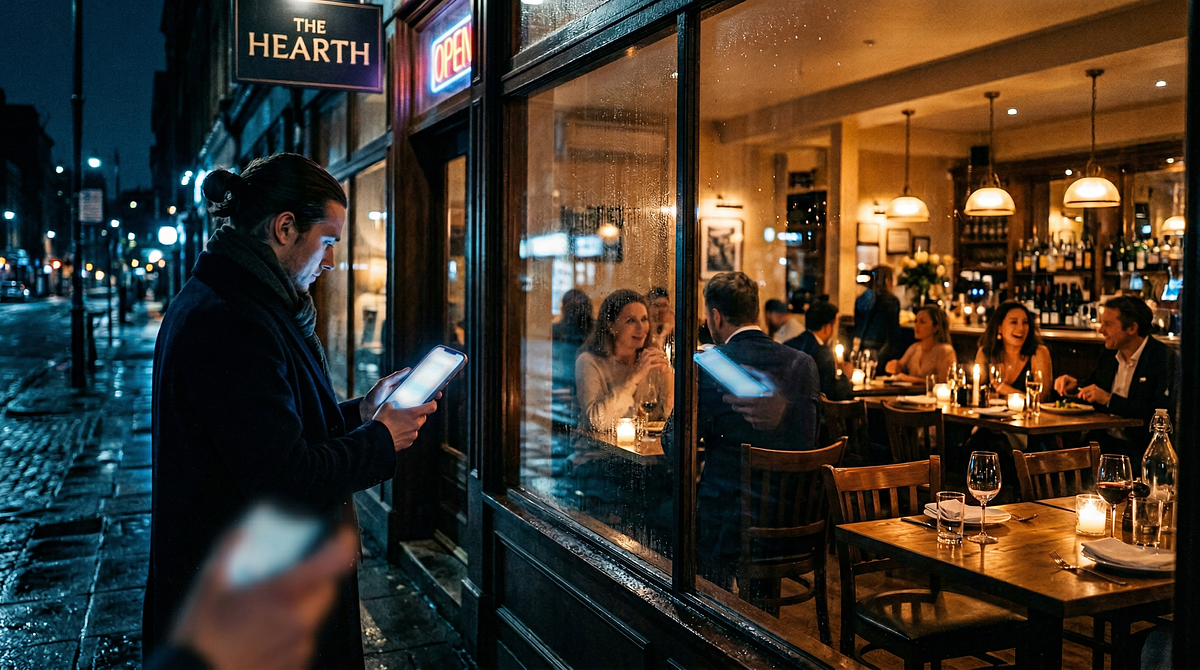
A couple arrives at their hotel in Naples - let's say they're staying near Bayfront. It's 6:30 p.m. They're tired from travel but excited to explore. One of them picks up their phone and asks ChatGPT: "Where should we eat tonight near Fifth Avenue South? We want something local, not a chain, outdoor seating if possible."
Here's what doesn't happen: they don't get ten blue links and start clicking through restaurant websites. They don't read three menus and compare parking situations.
What happens is this: the AI synthesizes hundreds of sources - Google reviews, Yelp listings, TripAdvisor ratings, menu data, social mentions, structured schema on websites, third-party delivery listings - and in three seconds, presents a curated recommendation. Maybe two or three options, ranked with brief descriptions, current hours, and a note about the patio.
They pick the first one. Decision made. No website visited. No list browsed.
That's the zero-click dining decision. And it's happening thousands of times per day across the Gulf Coast.
The Platforms That Now Own the Decision Moment
When I say "AI platforms," I'm not talking about some distant future. I'm talking about the tools your guests are actively using right now: Google AI Overviews, ChatGPT, Google Gemini, and Perplexity.
These platforms don't operate like a search engine with a ranked list of options. They function more like an exceptionally well-read concierge who has already read every review, every menu, and every social post about the restaurants in your market - and they're confident enough to give a direct recommendation.
The critical distinction is this: your guests are no longer browsing results. They are accepting recommendations.
That is a complete inversion of how restaurant marketing has worked for the last twenty years. The guest used to be the active agent, clicking and comparing and choosing. Now, they are largely passive. The AI does the selecting. And if your restaurant isn't in the AI's consideration set, you don't lose to a competitor. You simply don't exist in that moment.
As DoorDash's 2026 restaurant SEO guide confirms:
"guests can decide where to eat without clicking a single website."
Your Website Is No Longer the Front Door
This is the hardest mental shift for restaurant operators and their marketing partners - and I say that as someone who has spent 35+ years helping businesses build exactly these kinds of digital presences.
For years, the website was the center of gravity. Everything pointed to it. SEO was about driving traffic to it. The goal was to get the guest there.
That model is no longer accurate.
Your entire digital ecosystem is now the front door. Your Google Business Profile, Yelp listing, TripAdvisor page, delivery platform presence, review velocity, structured menu data, and the consistency of your name/address/phone number across dozens of directories - all of it functions together as the primary interface between your restaurant and the AI systems making recommendations on your behalf.
Over 40% of AI search recommendations come from citations and third-party listings, not from the restaurant's own website content, according to data from "The AI Dining Revolution," a comprehensive analysis of AI search behavior in the restaurant industry.
The restaurant that has an incomplete Google Business Profile, inconsistent hours across platforms, a menu that hasn't been updated since October, and a trickle of reviews from six months ago - that restaurant is invisible to an AI making a dining recommendation. It doesn't matter how beautiful their website is.
Nation's Restaurant News confirmed in January 2026: "Zero-Click Search Is Now the Norm" for restaurant discovery. The recommendation engine has replaced the research process entirely.
Why the Gulf Coast Is the Epicenter of This Problem
I'm headquartered in Michigan. I have offices in Bradenton. I have spent considerable time studying the Gulf Coast dining market, and I'll be direct: this region is uniquely exposed to the zero-click disruption.
Consider what's at stake.
Naples alone has approximately 675 restaurants competing for attention in a relatively compact geography. Collier County's population sits around 411,000 - but with one of the highest median household incomes of any county in Florida. These are wealthy diners with high expectations and, critically, the disposable income to dine out frequently and at premium price points.
Fort Myers tells a similar story from the visitor economy angle. According to the Lee County Visitor & Convention Bureau's 2025 tracking data, 25% of all visitor spending in the Fort Myers area goes directly to restaurants - representing hundreds of millions of dollars annually, and that's just one quarter's data. Spread across the full tourism season and add in Bonita Springs, Cape Coral, and Estero, and the dining economy across the Gulf Coast runs into the billions.
These are not casual dining dollars. They are discovery-dependent dollars. Visitors don't have loyalty yet. They're asking AI where to eat tonight. Locals have more options than ever and increasingly rely on AI tools to cut through the noise.
The restaurant that wins the AI recommendation wins the table. The one that doesn't may never know what it missed.
The Adoption Gap: Three Out of Four Operators Haven't Adapted
Here's the data point that I find most striking - and most telling.
Only 26% of restaurant operators currently deploy AI tools in their businesses at all, according to the National Restaurant Association's State of the Restaurant Industry 2026 report. Among full-service operators using AI, marketing is the primary application - but we're still talking about a fraction of the industry.
Meanwhile, 81% of operators say they plan to use AI more in the future, per Toast's 2025 Voice of the Restaurant Industry Survey.
Read those two numbers together. Three out of four operators haven't adapted. But four out of five say they know they need to. The industry sees what's coming and is watching it arrive.
That gap between intention and action is where restaurants lose ground permanently.
This isn't a technology trend that will plateau and stabilize. The AI systems making dining recommendations are getting smarter, faster, and more authoritative every quarter. The gap between the restaurants that have optimized for this environment and those that haven't is widening in real time.
The Operational Marketing Imperative
At Ignite XDS, our philosophy has always been that marketing and operations are inseparable. You can't market your way out of an operational problem, and you can't operate your way out of a marketing one. They are functions of the same system.
The zero-click dining decision validates that philosophy completely.
Winning in this environment isn't purely a marketing task. It requires operational precision: maintaining accurate, consistent data across every platform, managing reviews actively, structuring menu information so AI systems can parse it, responding to guests publicly in ways that signal trust and engagement. These are operational disciplines that have marketing consequences.
The restaurants winning in AI-driven discovery have figured this out. They've stopped treating their Google Business Profile as a set-it-and-forget-it listing and started treating it as a living, mission-critical asset. They've stopped treating online reviews as something that happens to them and started treating review velocity as a KPI they manage weekly.
The shift from browsing to accepting isn't just a consumer behavior change. It's a mandate for how restaurants must operate their digital presence - with the same rigor they bring to their kitchen, their service, and their cost management.
What This Means for Your Restaurant - Starting Today
The restaurants across Naples, Fort Myers, Bonita Springs, Cape Coral, and Estero that recognize this shift and act on it decisively today will dominate their markets over the next three to five years. The ones that wait - operating on assumptions about how guests find them that ceased to be true years ago - face something more serious than a bad quarter.
They risk becoming permanently invisible to the AI systems that now govern the dining decision.
This is the opening argument of a ten-part series I'm writing on AI and the future of restaurant marketing on the Gulf Coast. In the articles ahead, I'll get into the specific mechanics: how to optimize your Google Business Profile for AI recommendation engines, how review velocity works as a ranking signal, how structured menu data changes your discoverability, and what the next wave of AI dining tools looks like.
But before any of that tactical work matters, you have to accept the strategic premise: the guest is not going to your website first. The AI is deciding for them. And what that AI knows about your restaurant - the accuracy, freshness, and completeness of your digital presence - is now the most important marketing variable you control.
If a couple arrived at a hotel in your market tonight and asked ChatGPT where to eat, would your restaurant come up? How do you know?
Talk to Ignite XDS: https://www.ignitexds.com/fit-call
By Mitch Lipon, Ignite XDS