Your Menu Is Invisible - And It's Costing You Covers Every Night
Imagine a couple celebrating their anniversary in Naples. They're staying at a resort on Fifth Avenue South, and tonight has to be special. One of them opens ChatGPT and types: "romantic anniversary restaurant with a tasting menu near Fifth Avenue South Naples Florida."
Your restaurant is exactly that. You have a chef's tasting menu. You have a wine pairing. You have white tablecloths and soft lighting and a reputation your regulars love. But in the next three seconds, AI names three other restaurants - and yours isn't one of them.
Not because your food is inferior. Not because your reviews are weaker. Because the AI could read their menus and couldn't read yours.
This is happening right now, on the Gulf Coast, every single night.
Why AI Can't See Your Menu
Let me explain this in plain language, because it matters and most operators haven't fully grasped it yet.
When a guest types a natural-language query into ChatGPT, Perplexity, Google's AI Overview, or any other AI-driven search platform, the system goes looking for specific, structured information to build its recommendation. It's not skimming the way a human might. It's parsing data - ingredients, dietary attributes, preparation methods, price points, flavor descriptors.
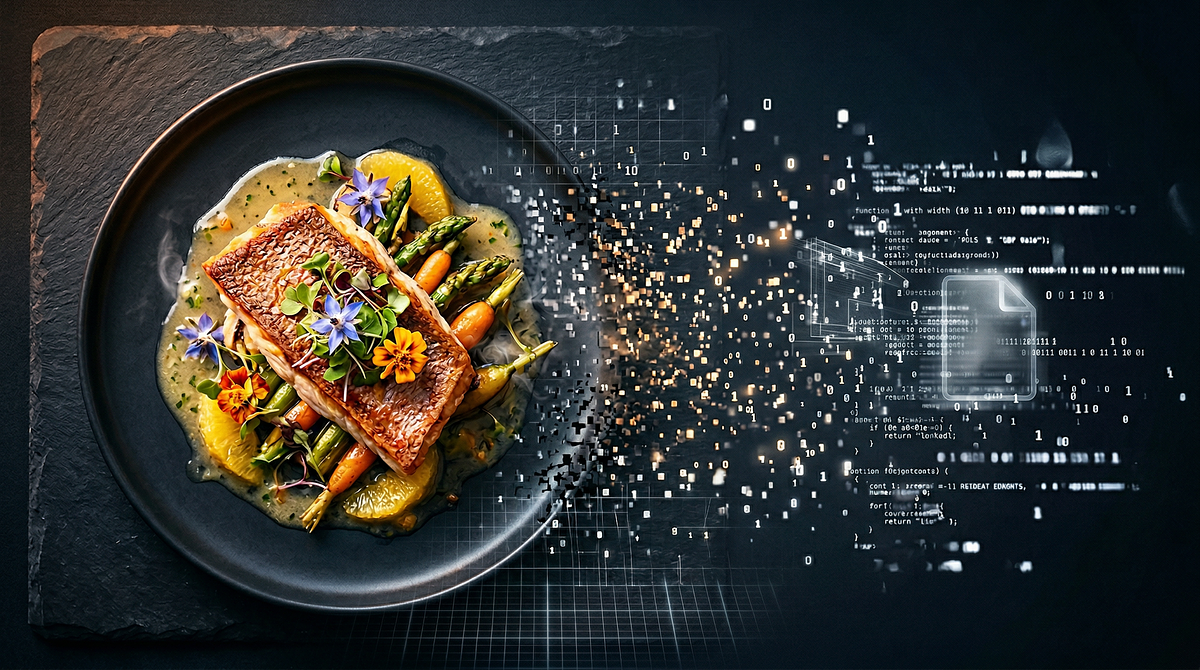
If your menu lives as a scanned PDF - a photographed image of your printed menu - the AI cannot read it. Full stop. There is no underlying text to parse. No ingredient list. No mention of your grouper preparation or your gluten-free pasta or the fact that your house-made pasta uses local Gulf shrimp and a thirty-year-old family recipe.
The same problem exists if your menu is a beautifully designed graphic file - a JPG, a PNG, even a stylized PDF built in Canva or InDesign. If there's no machine-readable text beneath the design, the AI sees nothing but a pretty image.
Your most compelling differentiators - your chef's tasting menu, your seasonal specials, your fresh Gulf catch - are invisible at the exact moment a guest is actively searching for what you offer.
The Way Guests Search Has Fundamentally Changed
This isn't a small technical footnote. The way people search for restaurants has undergone a structural shift in the past 18 months, and the implications for Gulf Coast operators are severe.
Guests used to search "Italian restaurants Naples FL" and then click through a list. Today, they're asking AI complete, conversational questions: "Where can I find a quiet waterfront restaurant with fresh Gulf seafood and a great wine list near downtown Naples?" Or "best gluten-free pasta in Bonita Springs" or "where can I get pan-seared grouper in Fort Myers" or "family-friendly seafood restaurant with outdoor seating in Estero."
These are not keyword searches. They are requests for recommendations - and AI systems answer them by matching query intent against the most detailed, structured data they can find. As the DoorDash 2026 SEO guide states plainly: "If your menu data isn't structured, detailed, and up to date, AI can't connect those dots - even if you're a perfect match."
Think about what that means for a 44-seat restaurant in Cape Coral with exceptional grouper and no text-based menu. The couple in Fort Myers searching for exactly that experience - Gulf-fresh fish, carefully prepared - gets routed somewhere else. Not because you lost on quality. Because you lost the data match.
What's at Stake on the Gulf Coast
I want to be specific about the competitive context here, because it's easy to treat this as an abstract technology problem. It isn't.
Naples alone has 675 restaurants competing for covers. The Gulf Coast tourism season compresses enormous decision-making volume into a relatively short window. Seasonal visitors are making snap decisions with their phones. Affluent residents - the demographic that drives high-ticket dining throughout Collier and Lee County - research extensively before they commit to an evening out.
Over 40% of AI search results for restaurants are derived from citations and listings rather than website content - and your menu data feeds directly into how AI evaluates and recommends you.
In that environment, if your menu is invisible to AI, you're not competing. You're simply absent.
And this connects directly to what I wrote about in Part 1 of this series: 70% of searches now end without a click. The AI delivers its answer in the results page itself, and the guest never visits your website. If you're not in the AI's answer, the guest doesn't click through to discover you. You simply don't exist for that search.
Menus Have Become Discovery Engines
Here's what Marqii's 2025 research captured: "In 2025, menus became one of your most powerful discovery tools."
That's a significant reframe. A menu used to be a reference document - something a guest consulted after they were already seated, or maybe glanced at on OpenTable before making a reservation. In the AI era, your menu is a dynamic, actively-searched data asset. AI platforms now highlight specific dishes, ingredients, and dietary attributes directly in search results.
Nation's Restaurant News put it clearly in March 2026: "Menus are no longer passive reference points. In AI-driven search, they are one of the most powerful discovery assets a restaurant has."
The restaurants winning on AI-driven platforms are the ones who figured this out early. They publish their menus as structured HTML with detailed descriptions that include ingredients, preparation methods, dietary attributes, allergen information, and flavor profiles. Each dish becomes a discoverable, citable asset. Each dietary tag becomes an answer to a potential search query. Each preparation method becomes context that helps AI match the right guest to the right table.
When a guest in Naples asks "best pan-seared grouper near me," and AI recommends a specific restaurant, it's because that restaurant's menu description told the AI exactly what it needed to know - the fish, the preparation, the accompaniments, the flavor profile. The recommendation wasn't random. It was data-driven. And it rewarded the operator who did the structured data work.
Marqii's research further confirms that structured menus with schema markup help AI systems understand exactly what you offer - from happy hour times to dietary options. This is the architecture that transforms a static menu into a discovery engine.
Test It Yourself - Right Now
Before we go further, I want to give you a moment of clarity that's worth more than any report I could share. Open ChatGPT. Type: "Find me a [your cuisine type] restaurant in [your city] that serves [your signature dish]."
Did your restaurant come up? If it didn't, your menu isn't visible to the AI. If a competitor did come up, go look at their menu online. I'll wager you find detailed, text-based descriptions with specific ingredients, preparation language, and dietary tags. That's not coincidence. That's strategy.
Now try it with a specific dietary query: "gluten-free options in [your city]" or "vegan-friendly restaurant near [your neighborhood]." If you've invested in dietary accommodations and they're not showing up here, the guests who would love your restaurant are being routed elsewhere.
The Practical Path Forward
The structured menu conversion is the single fastest win most Gulf Coast operators can implement - and one of the highest-impact changes you can make with relatively low technical overhead.
Here's what the best operators are doing:
- Convert scanned and graphic menus to text-based HTML. Not a redesign of your full website. Just ensuring that the menu data that lives on your site - and is pushed to third-party platforms - is machine-readable. Your designer can maintain the visual elegance; the underlying text is what the AI needs.
- Write ingredient-level descriptions for every dish. This isn't just for AI. It improves the guest experience and handles the 40% of diners who check menus online before visiting. But for AI purposes, descriptions like "pan-seared Gulf grouper with roasted fingerling potatoes, lemon caper butter, and wilted local arugula" give the system the specific, parsable detail it needs to match your dish to a guest's query.
- Add accurate dietary tags. Gluten-free, vegan, dairy-free, nut-free - these are search terms guests are actively using. If your dish qualifies and the tag isn't there, you're invisible to that query.
- Implement schema markup. Schema is structured data code that helps AI and search engines understand exactly what your restaurant offers - from your hours and cuisine type to your menu items, price range, and dining experience. This is where your developer or digital marketing partner earns their keep. Done right, schema markup transforms your menu from a document into a data source.
- Keep it current. Seasonal specials, limited-availability dishes, fresh Gulf catch - if the menu on your site is six months behind your actual service, you're not just leaving AI recommendations on the table, you're actively creating guest disappointment when they arrive expecting something you no longer offer.
The Fastest Win You Have Right Now
I've spent 35 years watching operators make expensive, complex marketing decisions when a targeted, lower-cost action would have moved the needle faster. Structured menu conversion is that action right now.
It doesn't require a full website rebuild. It doesn't require a new photography budget or a brand refresh. It requires looking at your current menu - the one guests and AI platforms actually see - and asking a hard question: Can a machine read this? Can it find my grouper? Can it surface my gluten-free pasta? Can it tell a couple planning an anniversary dinner that my tasting menu is exactly what they're looking for?
If the answer is no, you have a solvable problem. And solving it puts you in the conversation at the exact moment high-intent guests are making their decision.
On the Gulf Coast, where 675 restaurants are competing for every cover in Naples alone, and where affluent seasonal visitors make snap decisions based on AI recommendations they trust - being in that conversation isn't a nice-to-have. It's the game.
The AI doesn't know your restaurant is great. It only knows what it can read.
Make your menu readable. Or we can do it for you: https://www.ignitexds.com/contact
Mitch Lipon is President and Founder of Ignite XDS, a strategic marketing firm founded in 1988 and headquartered in Brighton, MI, with offices in Bradenton, FL. With 35+ years of operational marketing expertise, Mitch works with restaurant and hospitality brands on the strategic intersection of marketing, operations, and emerging technology.